

Segregation was normalized when people decided to rename the process as the “freedom of association.” In the book White Flight, Kevin Kruse denotes how different business owners in Atlanta decided to use their status as business owners to control how communities were shaped and what policies were enacted. Atlanta was just one city which Kruse had specific information on, but because racism and segregation are predictable behavior patterns, repetition can be found all over the United States. In fact, the way some places in Dallas are going, there will be nothing for anyone to do unless they have enough money to leave their homes. Compare how the area around the City Halls looks while being just down the street from the AT&T Center. Which would attract anyone in the middle of the day in August, and why?
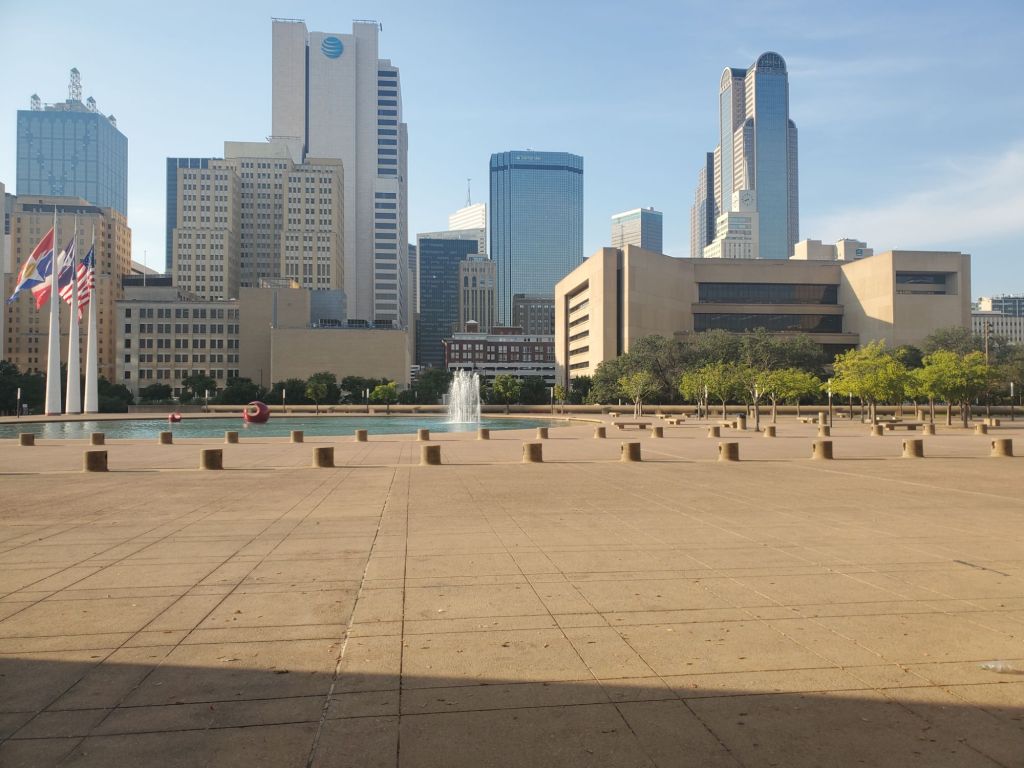

Privatizing space is another way of enforcing the dominant narrative because it tells people that they need to earn the right to be seen in public. Not only are jobs difficult to get these days, but they pay less and everything costs more money that people have a hard time earning. The obsolete belief that people will eventually earn more and more money is a fantasy based on a time period that no longer exists. However, think about the last time that there was a development that had anything other than retail involved. Every single new mixed-used area is centered around people spending money, and every event is centered around merchandising and vendors. Moreover, places with retail often have extensive security, since the purpose of policing is to protect private property. How is anyone supposed to go out in public and feel safe if every new construction project screams, “Spend more money!”
Having public squares that become shopping malls is far from the only goal of privatization. Most of the new “housing” being built is considered luxury, which means that developers and cities are only trying to attract people with money. At the same time, no one wants to consider that people without money could potentially become homeless, which is why there are so many anti-homeless ordinances around the United States. People accepted by the dominant narrative want to ignore all the problems their selfish behavior causes, which is why landfills are placed in poorer neighborhoods despite the wealthy neighborhood’s overconsumption. Privatizing public space also allows people to believe that everyone within that space earned the right to be considered human, and “others’ encroachment” denotes envy, or something.

Finally, corporate sponsorship and privatization is the opportunity to erase history. In Austin, Town Lake was renamed Lady Bird Lake after Lady Bird Johnson was harassed on her deathbed by her granddaughters. To everyone else, the city was honoring the former First Lady, but the woman herself had expressly asked not to have anything named after her. In the photo above, people would have a truly difficult time finding the original theatre, despite its being on all mapping platforms. Another example from Austin includes the erasure of the destruction of the only Black firehouse, which currently hosts a carwash. Around the country, there are countless examples of history being erased because someone with money bought the land and changed everything, while none of the new residents know or care to find anything out before becoming offended when anyone offers to educate them.

If everyone were allowed to have inalienable private space, perhaps this concept would be more palatable. However, those within the dominant narrative have encroached upon and destroyed the property and rights of others without a single hesitation. Even now, Louisville is continuing to “discuss” an ordinance that would demand that developers stop introducing projects designed to destroy historically Black communities. In short, unless the dominant narrative respects the property rights of everyone, then no one should have private property rights.
 Chasing A Dying Empire