
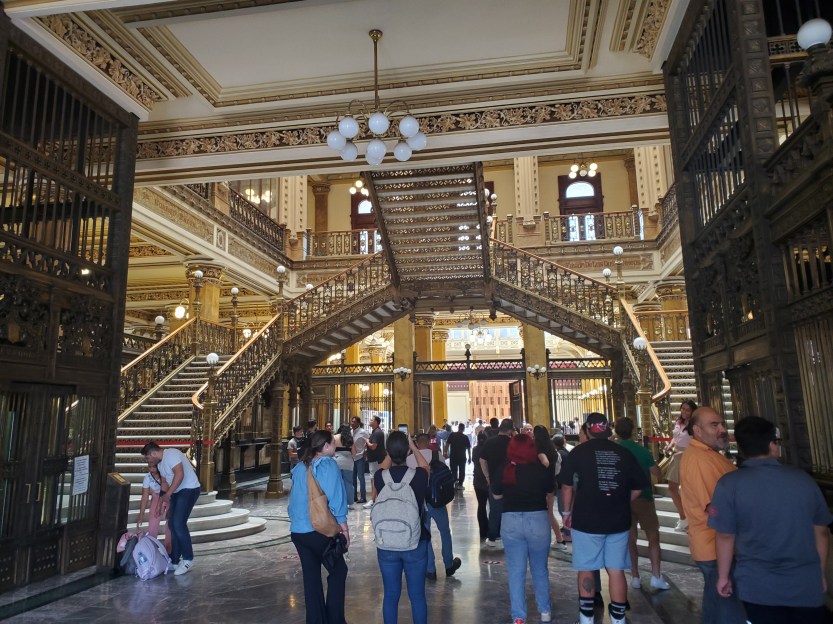
Last night in Guadalajara, the Center for Architecture and Urban Culture hosted a talk with Carla Escoffie discussing who has the right to a city. She detailed how rights are determined on multiple government levels, and mentioned various activism efforts to reclaim space. She also mentioned that the cost of living was another way cities were denying universal access. However, in Mexico City, it seems that the downtown area has become little more than a tourist destination, meaning those with money beyond middle class are the only ones who feel welcome.
Cities offer a great deal of tourism as they are the first place anyone considers when visiting a new country. Of the many cities that are not car-centric, Brussels has been the first that seemed centered only on its residents. Downtown areas attract the most attention because of how walkable they tend to be. Mexico City is not only the capitol of the country, but one of the first places anyone considers when thinking of the country as a whole. Without money, however, Mexico City involves waiting in line and watching other people have fun.
There are several reasons not to simply cater to tourists in a downtown area, the first being that city residents are already paying for it. Businesses get tax incentives, and commercial real estate is expensive based on “anticipated income,” but rent-paying shoppers are simply existing. Privatizing the majority of the public space means that regular residents pay twice any time they choose to come downtown. Decreasing incomes mean that fewer people will be able to afford such a luxury.
Speaking of decreasing incomes, people have less and less disposable income. It has been an international pastime to mock the poor; the problem is that more people have become poor, so that means less travel. Therefore, “anticipated income” is a relic of the past, as more people struggle to afford basics. Catering to people who may never show up is an exercise in foolishness.
Finally, making downtown areas attract solely tourists is short-term thinking. Even though elections encourage moving away to international locations, many people travel first to find new locations. If they go to downtown areas with just recreational activities, all they can consider is how much effort they would need to spend to get to resources. Downtown areas that take an hour round-trip get to resources on foot are not good locations for people with families.
At the end of the Gilded Age lies despair, and the scariest part is that people are unsure if all locations will recover. In human history, there has always been “later”–until now. Mexico City is running out of water, but instead of thinking about xeriscaping and bioclimatic architecture, more resorts with air conditioning are under construction. Maybe if the city aspires to last beyond the next couple of years, attention should be paid to the majority of the public, rather than the minority of the tourists.
 Chasing A Dying Empire