

Before I learned what I learned about the Appraisal Foundation–a private entity protected by public law that sets appraisal standards for property values in the United States–I was in favor of tax incentives for housing. I had been taught by a number of misguided individuals that building was the only way to decrease housing costs, and as a struggling government employee in my late 20s, I believed that the world just needed more development. There was no proof that building decreased housing costs, but city officials and developers kept insisting that it was because the city simply needed more housing. In 2024, Austin still has the some of the most expensive housing in the nation with some of the worst wages, but luxury housing combined with retail is still being crammed everywhere. At this moment, one can see that the concept of a housing project has mutated and become something horribly wrong.
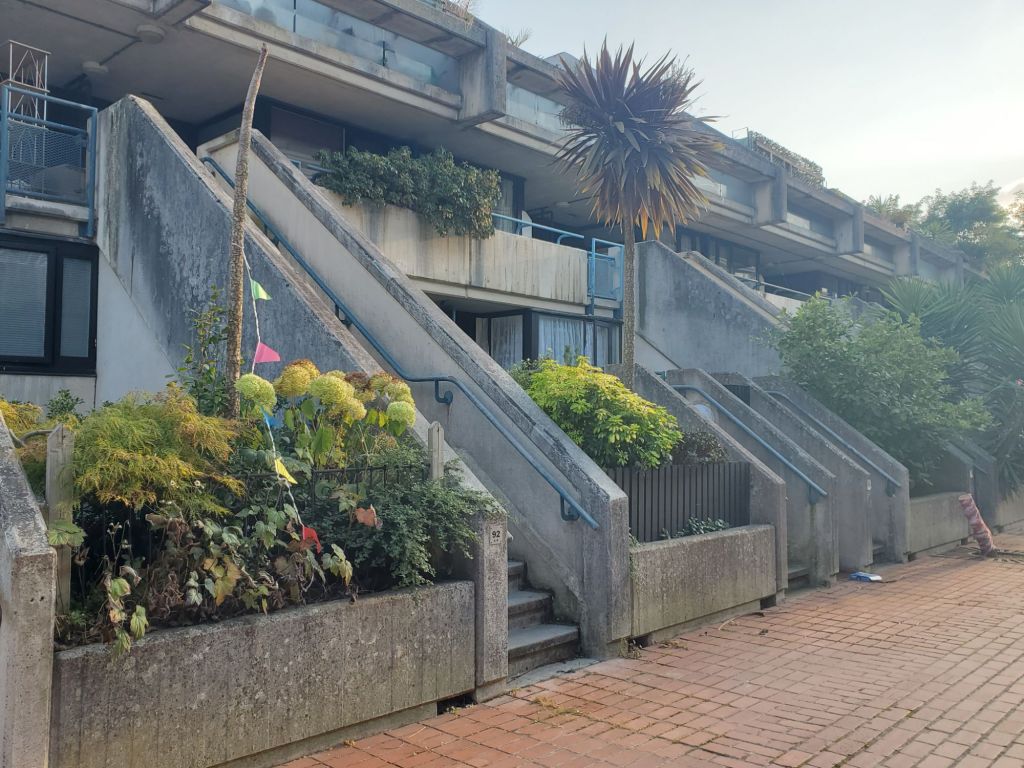

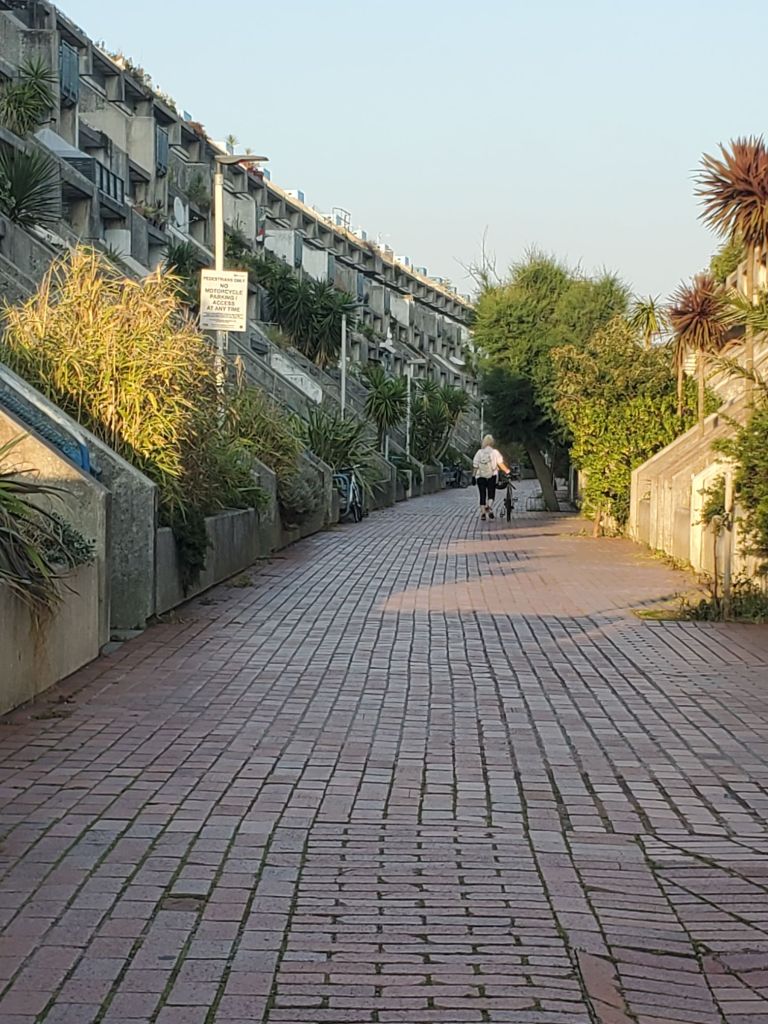
In London, we were slated to see three public housing projects that showcased twentieth-century architecture at its finest, and all three were evidence of the direction that housing projects were headed. Alexandra and Ainsworth Estate was my favorite because as we passed through there, people were simply living their lives. People even asked why we took pictures because they found nothing remarkable about their space, which is the way it is supposed to be. As I have already stated, architecture houses life, and when people no longer feel free to live autonomous lives, it ceases to fulfill its function. Walking through the sidewalk through this project, I went to the end and watched people come and go as the sun set. I felt comfortable, and the people did not feel gawked at because I was a safe distance away from their homes. Apparently, there are tours due to the architectural significance, but those are about once a week.


The second housing project that evolved was the Barbican, and this project was a lot less comfortable to sit at without feeling like I should be spending money. There was a public library and a school, but other than the housing, the space was all businesses. It was difficult to find a place to relax because 1) there was a graduation, which no one but residents or school affiliates could have known, but 2) there were multiple restaurants that were beginning to fill with people based on the end of the day. Residents were likely undisturbed because of the shear height of the Barbican, but it was clear that the area was becoming a circus. Surrounding the area were also private office buildings and businesses, with a small park as relief, but not a place people lingered unless they had disposable income.
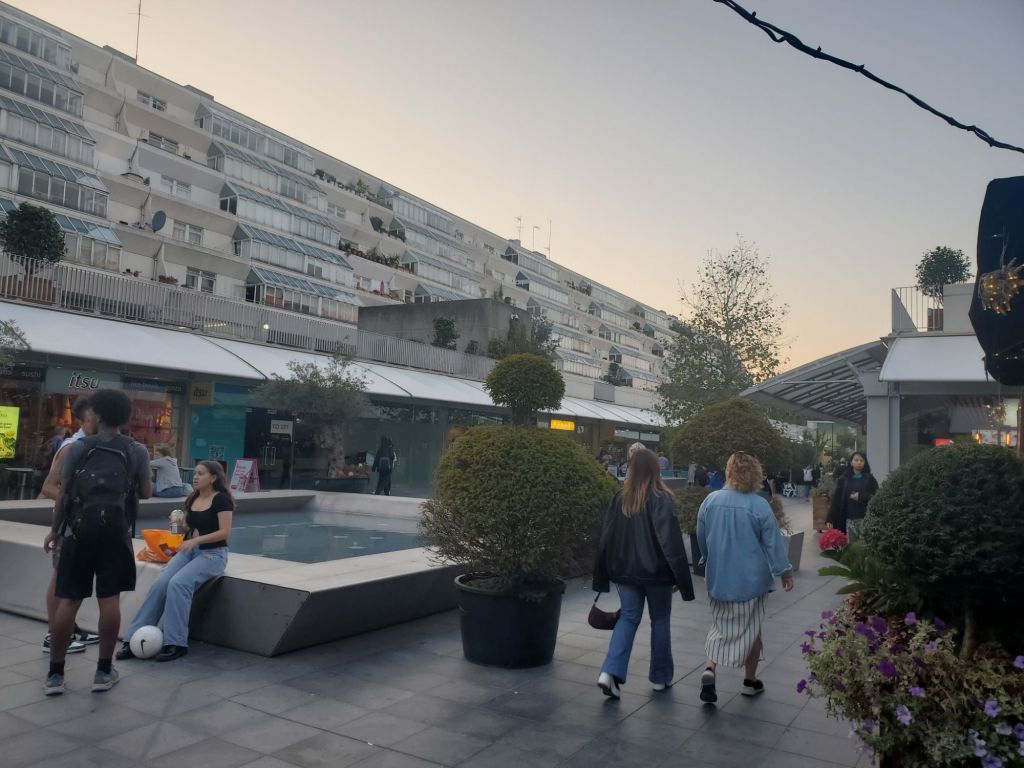
It was difficult to tell that the Brunswick Estate was a housing project because the first thing one saw was all the stores and restaurants. The interior courtyard had been almost completely privatized, and there were security guards watching at all times. Even though there were benches, all the benches stared into stores and restaurants, so that people could relax by watching people shop. The residents were above the stores and consumers could not access the small strip of terrace above, but even the terrace looked down at the stores and restaurants. Hopefully live music would be kept to a minimum, but for a housing project, the retail seemed incredibly invasive.
All obsessions are problems, and the obsession that developers have about putting retail on the ground floors of all residential complexes is an obsolete concept. That was a short-term solution based on outdated models of anticipated increases in disposable income. With a large middle class, having retail everywhere was possible because people were able to make up the shortfall without going into debt. Income has stagnated over the past fifty years, and it is unrealistic to pretend like everyone is going to go into debt to help the first floor retail survive. Unless the first floor businesses are grocery stores, affordable day cares, and healthcare clinics, they should not be on the first floor of a residential area in 2024. Mindlessly believing that profits will rain from the sky is wrong.
Additionally, while everyone is being pressured to start a business, not everyone has the reserves to afford operating costs. The plight of commercial real estate is unknown because people are forming online businesses and using international labor to cut costs. Business loans are not only difficult to acquire, but another source of gambling on the stock markets, which is the main reason people are being told to start businesses. Thus, if people cannot afford to rent/purchase storefront commercial realty in a residential area, the first floor starts to look like an eyesore. Worse, it becomes dangerous because there are no eyes on the street and the space entices criminals to prey on the residents. Even banks on the first floor is a bad idea because all financial institutions have proven themselves to be predatory.
The principal behind vertical mixed use development was that the business would be on the first floor while the business owners would be above the space. In this way, if anyone broke into the space or there was some other emergency, the owner would be right there and available to handle the problem. In this current era, no one knows where the business owner is located, especially when housing is one of the biggest and fastest growing businesses. People in other countries own properties in the places where they enjoy vacationing, and storefront operators live in the suburbs. First floor businesses have sky scrapers above them, so there is no telling where the business owner is, or if the owners can even afford to live in the same place as their business.
For all the tax incentives, residents keep being promised that there will be affordable living. Unsurprisingly, when developers get their incentives, they are less inclined to offer any affordable living, demanding that people prove that they cannot afford market rates. Ask anyone who has found the ten apartments in a multibuilding complex, and they will tell you that it is a mountain of paperwork that is constantly renewed. People inclined towards extraction are not interested in making communities work; they are interested in making money, and that is not what housing projects or complexes should be about when people are struggling to close doors.
One reason that developers like first floor retail is that it distracts people from the existence of poverty, which is the only real reason anyone is frustrated in a housing project. Keeping everyone thinking that life is a party means that if a resident cannot participate, the resident should do everything in their power to engage. So many people cannot afford the market rate, and it is unclear what “market” any of the housing is geared towards, making obstructions of all of these housing complexes to solving the problem at hand. People were told that building would reduce housing costs, but all that keeps happening is rich people buying to provide the appearance of demand.
Feeling trapped in one’s own home is one of the most uncomfortable feelings. With retail and restaurants on the first floors of all these areas, the surrounding space is immediately private. There is no space for residents to congregate because there are likely security guards protecting the retail. Imagine coming home from a terrible day at work and being accosted by multiple clerks offering samples or trying to draw folks into the business. What about the parents with cranky children who are coming home from grocery shopping, and have no interest in fending off more temptation? People have been pushed into homeownership precisely because that is offered as the only solution to not being pressured to consume nonstop.
On that note, having businesses constantly hawking their wares outside homes in this 24-hour society means that no one gets to rest at home. Even if nobody looked at a single screen, they would still be compelled to consume because the only way to capture any income is to stay open for a long time. There are quiet businesses, but having multiple jobs and not having services around one’s home means that at home, people afford little, and outside their home, they have to think about keeping the businesses open for safety. Existence should not require so much effort that people cannot stop working or stop paying attention to the needs of business owners. That is a stressful life.
In the cases of the Barbican and Brunswick, the theory behind adding retail and restaurants appears to be that the income would help preserve the property. Unfortunately, income based on consumption means everything that comes with consumption, including inequality and crime. If the standards of any housing project or complex should be maintained, it is that of the Alexandra & Ainsworth Estate. People need to be able to go home and stop thinking about how to keep rich people rich, and everyone deserves the right to go home.
 Chasing A Dying Empire