
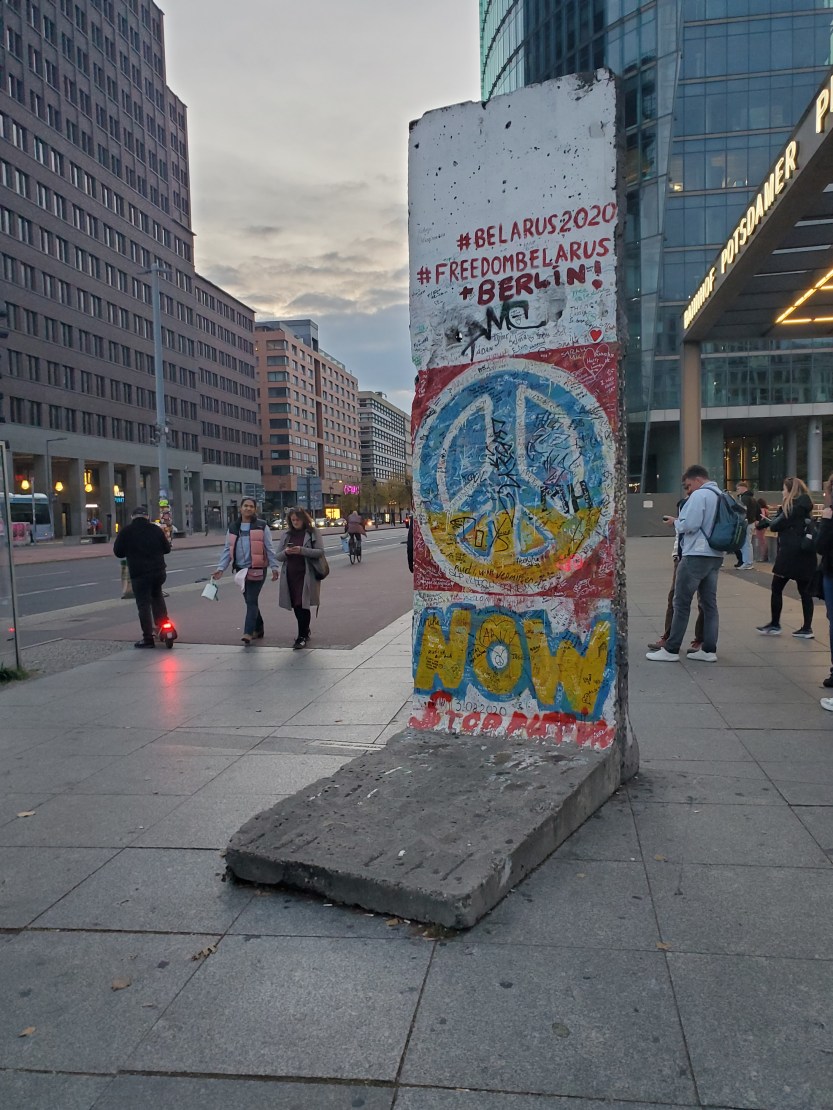
Having been in Berlin in the past four months, I can tell you that I was very impressed by the fact that everything seemed to be humming right along without much interruption. Everything was easy to navigate, and I never felt like I needed excessive directions to get from one place to another. Obviously, this is because I do not live in Berlin, and I did not need anything to be working in any particular order. For Berliners, the trains were always late or nonexistent, the buses were out of order, and none of the transportation seemed to be functioning well, even for a migrant from the United States who had been there for twenty-five years. What I perceived as order was perceived as dysfunction for those living within the system, and both perspectives illustrate the confusion when things go wrong for the privileged.
I was a person of some privilege by being able to travel in the first place, and I was not required to find a place to stay because I stayed with my companion’s relatives. Had we been forced to find a place to stay, we would likely have been forced to have more money than we were able to produce, and we would also have had to navigate the city without direct guidance. While there, we noticed several unhoused people, and despite the attractive appearance of the city, we later learned that the inequality was so unbearable that the country collapsed shortly after we left, a fate befalling a number of countries in the past few years. Looking at a system from the outside gives the privileged an entitled vantage point because after all, we get to leave and will not be forced to manage any dysfunction we may miss. We look at a complex tapestry and offer easy answers, often from the safety of our personal devices before we have to switch to airplane mode.
Conversely, Germany has been a very blessed country for at least twenty years, especially considering that it was previously able to sustain multiple viewpoints under one umbrella. Based on climate change, workers were encouraged to take long breaks during the hottest hours of the day, similar to siestas which originated elsewhere. Germany also has a number of companies outsourcing their labor to other countries, many of which also enjoy extracting resources elsewhere in favor of the parent company in Germany. Therefore, what people see as dysfunction may have also arisen from the fact that extraction and exploitation tend to have costs, and despite any stability the country may have enjoyed, none of that stability occurred in a vacuum, and the consequences are finally being shown to the world.
Most of the planet is experiencing a meltdown based on false equilibriums in which people were privileged enough to be hidden from accountability. In the United States, people will begin to see how alienating countries around the world will eventually effect the bottom lines. Now Germany has joined the so-called “developing nations” in its citizenry not trusting anything that the so-called leaders have to say. The middle class has all but collapsed based on the unsatiated greed of the few, and nobody has enough time, energy, or resources to call them out without facing distress. It is times like this that people would do well to remember that just because people were privileged to avoid seeing the problems before, does not mean that the problems never existed in the first place.
 Chasing A Dying Empire