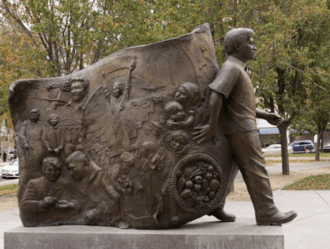
Cesar Chavez, the most recent. Eldridge Cleaver, from the 1960s and 1970s. Of course, Martin Luther King, Jr., smooth daddy and serial philanderer. What do all these “great men” have in common? All of them had great images and made significant social justice contributions to their communities, but each and every one of them had questionable morals. These men are not the only ones to have such issues, but they point out a distinct problem with creating “heroes” in the activist circles, something I have talked about in my own accounting of the experience. Just like the Founding Fathers, it does communities of color no good to put people on pedestals because people are always human beings before they are whatever labels we would choose to assign to them.
Never forget that the reason that “great men” rose to power was racism and discrimination, when the dominant narrative refused to confront people that it knew should not have been controlled. Instead of building respect for non-white communities, there was a process of tokenization that began during chattel slavery and continues until this day. Essentially, the dominant narrative demands a “point of contact” to avoid dealing with others who are involved with the same issue because when people know they are wrong, they limit the accountability that others can enact. Committees, panels, “dialogues,” and “conversation” are all methods of avoiding accountability and the truth of what the dominant narrative does to the targets of its behavior.
When deciding who is “most worthy” to engage with, inequality creates an underbelly hierarchy, and all hierarchies are wrong. There may be a food chain, but human beings must decide whether they believe themselves above animals or not. Dodging service workers and anonymous community organizers is not a sign of collaboration, or an indication that one should be trusted. No one is inherently designated to rise above any other person, and we are all born the same way only to eventually die. To avoid the humanity of a group that one has oppressed is to pretend that everyone would turn out the same way if given the same set of circumstances, and as a child of socioeconomic privilege, I can tell you that such thinking is incorrect. Deciding which humans are “worthy” of protection is just another form of oppression, and if the dominant narrative had wanted to evolve, it would not need to recreate another hierarchy.
Finally, this is another reason that insecure idiots co-op movements to create pedestals that should not exist, and ultimately harm those movements. Shawn King from the 2020 protest movements has thankfully gotten out of the spotlight, and the BLM movement has not ended, but evolved so that financial impropriety could no longer be a part of the conversations. Ironically, Martin Luther King, Jr. spent the latter parts of his life avoiding the incessant praise of his nonviolent years because he knew that he was being used and stalked, and one wonders if he would have come to regret participation in the “peaceful” method of protest. When people see that nothing is ultimately changing, the right kinds of “leaders” step back from a certain practice and reevaluate, not continue as if the bad-faith actors just need a “kinder tone.” A good cue of whether someone is a leader or a grifter is whether they avoid the spotlight when they fail to see changed behavior.
Oppression does not end with a “Pick me!” party, and those who are striving to take the place of the “leaders” are wasting their time. I no longer participate in advocacy within the dominant narrative because I have seen time and again that after hours of walks, talks, and reports, those in charge will demonstrate their maladaptive behavior to the fullest. Rather than search for new mouthpieces, the discrimination and systemic inequalities need to be dismantled without conversations and meetings, just wealth redistribution and less public commentary from those who inflicted harm. The doing is the thing, not the talking anymore.
 Chasing A Dying Empire